From the Pernštejns to 2007
Lobkowicz Palace history
How a 16th-century palace in Prague Castle became the Lobkowicz family's house, a Baroque concert venue, a confiscated museum and a museum again.
Hold a seat in the palace hall ↗Quick answer
Lobkowicz Palace was built in the latter half of the 16th century by the Pernštejn family and passed to the Lobkowiczes by marriage. A Baroque rebuilding followed in the 17th century. The Nazis confiscated it in 1939 and the Communists in 1948. It was restituted to the family in 2002 and opened as a museum in 2007. The concert hall belongs to its Baroque phase.
Built by the Pernštejns
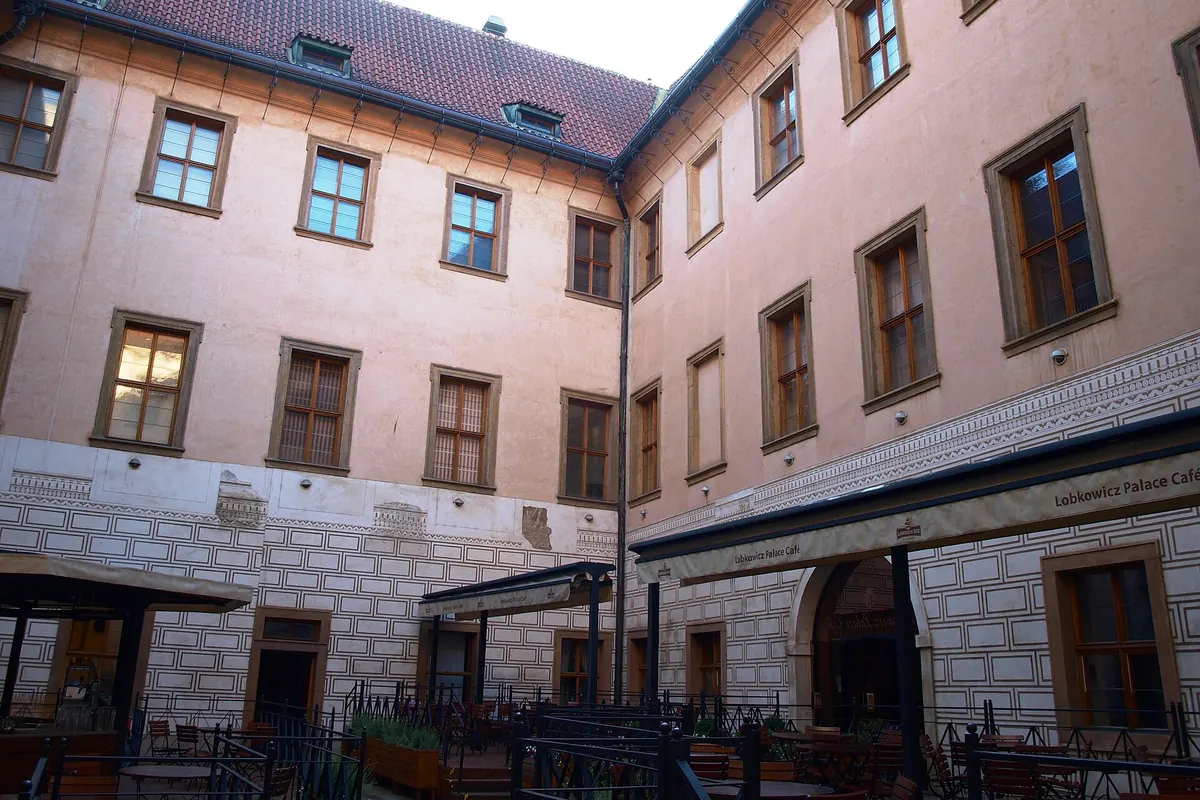
Wikipedia says the palace was built in the latter half of the 16th century by Jaroslav of Pernštejn, who lived from 1528 to 1569, and completed by his brother Vratislav of Pernštejn, chancellor of the Czech Kingdom. The palace's own site dates it to the mid-1500s. Both brothers belonged to the Pernštejn family, and the house they built is the core of the palace that later passed to the Lobkowiczes.
How the Lobkowiczes came to own it
The palace passed to the Lobkowicz family through the marriage of Vratislav's daughter Polyxena to Zdeněk Vojtěch, 1st Prince Lobkowicz, who lived from 1568 to 1628. Wikipedia adds that, after the Battle of White Mountain in 1620, the Catholic Lobkowicz family grew in influence for three centuries. The family's records go back much further: its own site gives 1390 as the first documented origin of the Lobkowicz family. For visitors, the practical point is that the name on the door is the name of the family that still owns the building.
The Baroque rebuilding
After the Thirty Years' War, Václav Eusebius, 2nd Prince Lobkowicz, made the major Baroque alterations and redesigned the palace in the Italianate style, Wikipedia says. The same article adds that the painter Fabián Václav Harovník decorated the ceilings of the Concert Hall and the Balcony Room. The palace's site describes the hall in which concerts are held as Baroque, with 17th-century frescoes. So the room you sit in for a midday concert belongs to this rebuilding, not to the 16th-century house before it.
Balconies, a hospital and a government
Wikipedia records three episodes in the next centuries. When Leopold II was crowned King of Bohemia in 1791, the 7th Prince commissioned the exterior reconstruction, and it added the panoramic balconies. Around 1811 the palace served as a hospital for soldiers wounded in the war with Napoleon. After the First World War, Maximilian Lobkowicz, who lived from 1888 to 1967, made rooms available to Masaryk's government. Each shows the palace as a working part of the castle, not a museum piece.
Two confiscations
The palace's site says that all Lobkowicz properties and collections were confiscated by the Nazis in March 1939, when Max Lobkowicz, an outspoken critic of Hitler whom the Reich soon declared an enemy, had already left with his family for London. Wikipedia says the palace was returned in 1945. In 1948 the Communist regime took all Lobkowicz property again, and Max, who had escaped once more, never returned to Czechoslovakia.
Return and opening
The Velvet Revolution began on 17 November 1989, and the palace's site says William E. Lobkowicz returned permanently to Czechoslovakia in 1991 to begin reclaiming the family's heritage. Wikipedia describes a twelve-year restitution process that returned the palace in 2002. The family then restored it, and the Lobkowicz Palace Museum opened in 2007 with its permanent exhibition. Wikipedia puts the restoration at four years and the museum at 22 galleries. The concerts and the museum share that story, which is why many guests visit both.
Why it matters for the concert
A concert in a palace that was confiscated twice and then returned sounds different from a concert in a hall built for the purpose. The family are patrons, collectors, performers and composers, in the palace's own words, and the programme reflects that with a suite by Philipp Hyacinth Lobkowicz. If you plan one visit to this palace, read the history first and the museum audio guide will mean more. The guide to Beethoven's patron picks up the family's musical side.
Read next: Beethoven's patron Lobkowitz
Frequently asked questions
Who built Lobkowicz Palace?
Wikipedia names Jaroslav of Pernštejn and his brother Vratislav, who completed it in the latter half of the 16th century.
When did it become a museum?
The museum opened in 2007, after the palace was restituted to the Lobkowicz family in 2002.
Who owns the palace today?
The Lobkowicz family, whose site calls it the only private, family-owned palace in the Prague Castle complex.
Which rooms are the Baroque ones?
The Concert Hall, where concerts are held, is Baroque with 17th-century frescoes. Wikipedia credits Fabián Václav Harovník with its ceiling.
Sources